
- February 1, 2020
- Pentesting and forensic reports
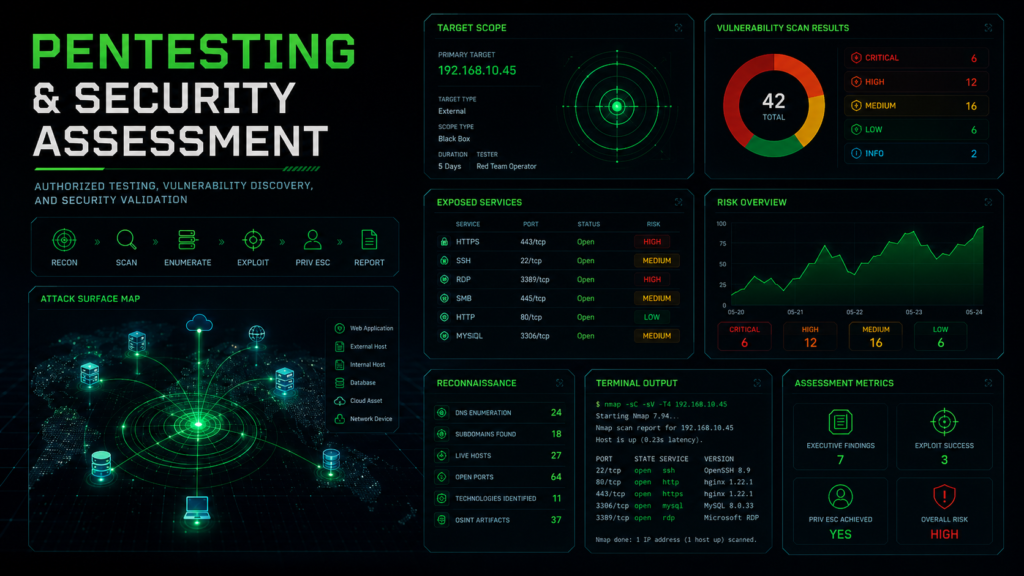
Project 1 Internal Penetration Test & Post-Exploitation Assessment
Category: Penetration Testing / Network Security
Overview
This project involved an authorized internal penetration test performed against a controlled, Docker-based laboratory network. The assessment simulated an attacker who had gained an initial foothold and attempted to discover internal services, exploit vulnerabilities, escalate privileges, pivot between network segments, and access protected systems.
Challenge
The main challenge was to determine whether the compromise of a single exposed system could lead to wider access across the internal network. The environment contained vulnerable and outdated services, weak credentials, insufficient segmentation, and several potential privilege-escalation paths that had to be verified without causing damage or interrupting the laboratory systems.
Solution
I followed a hybrid internal penetration-testing methodology combining automated reconnaissance with manual validation. After mapping the reachable hosts and services, I identified exploitable configurations, validated selected vulnerabilities through controlled proof-of-concept attacks, obtained elevated privileges, and used a compromised dual-homed host to access an otherwise isolated internal network.
My Role
I performed the complete assessment, including scope analysis, network reconnaissance, service enumeration, vulnerability research, controlled exploitation, privilege escalation, internal pivoting, evidence collection, risk classification, and preparation of the final technical and executive report.
Key Findings
The assessment confirmed eight security findings across three systems. The most significant issues included remote code execution through a vulnerable Samba configuration, weak or default credentials, insufficient network segmentation, outdated services, SUID-based privilege escalation, unrestricted database access, information disclosure, and the absence of effective security monitoring.
Key Features
Network ReconnaissanceService EnumerationVulnerability ValidationRemote Code ExecutionPrivilege EscalationPivoting & Lateral MovementCredential AssessmentRisk ClassificationRemediation PlanningTechnical Reporting
Technologies
Kali Linux · Nmap · Metasploit Framework · Netcat · LinPEAS · Searchsploit · Exploit-DB · John the Ripper · Hashcat · SSH · SMB · MySQL · Docker
The report documents Nmap for discovery and enumeration, Metasploit for exploitation and pivoting, Netcat for connectivity testing, LinPEAS for escalation analysis, and password-auditing tools such as Hashcat and John the Ripper.

Project 2 BIPEDAL-USB-2025 — Digital Forensics Investigation
Category: Digital Forensics / Incident Investigation
Overview
BIPEDAL-USB-2025 is a simulated digital forensics investigation involving a suspicious USB storage device discovered within a robotics organization. The objective was to determine whether the device contained confidential information, evidence of unauthorized data transfer, concealed communications, or activity connected to a suspected external organization.
Challenge
The device contained several layers of deliberate concealment. Files had misleading extensions, documents were encrypted or deleted, passwords were hidden inside NTFS artefacts, and additional evidence was embedded within images using steganography. The challenge was to recover and correlate these artefacts while preserving evidence integrity and avoiding conclusions that were not supported by the recovered data.
Solution
I examined a verified forensic image of the USB using file-system analysis, metadata inspection, keyword indexing, file carving, signature validation, password recovery, steganographic extraction, and NTFS timeline reconstruction. Each recovered artefact was correlated with the investigation questions and documented through a structured forensic report.
My Role
I acted as the forensic examiner and performed the complete investigation, including evidence verification, file-system examination, deleted-file recovery, metadata analysis, password recovery, steganographic extraction, timeline reconstruction, interpretation of findings, and preparation of the final forensic report.
Key Findings
The investigation identified evidence of deliberate preparation and concealment. A Microsoft Office document had been disguised as an image, deleted files were recovered from unallocated space, encrypted documents were successfully accessed, a hidden password artefact was discovered within NTFS metadata, and a second document was recovered from a steganographic payload.
Investigation Outcome
The combined evidence was consistent with a deliberately prepared data-transfer and communication device. Although direct attribution could not be established from the USB alone, the recovered artefacts demonstrated intentional concealment, operational planning, encrypted communication, and anti-forensic awareness.
Key Features
Forensic Image AnalysisEvidence Integrity VerificationFile CarvingDeleted File RecoveryFile Signature AnalysisPassword RecoveryEXIF Metadata AnalysisNTFS Artefact ExaminationSteganography AnalysisTimeline ReconstructionForensic Reporting
Technologies
Autopsy · The Sleuth Kit · ExifTool · office2john · John the Ripper · OpenPuff · NTFS Analysis · File Signature Analysis · Hash Verification